Saturday, 19 September 2015

Transient Stability of Power System using Facts Device-UPFC

IJSRD Found one good reserch article on Electrical Engineering Department

Abstract— This paper is based on Occurrence of a fault in a power system causes transients. To stabilize the system, The Flexible Alternating Current Transmission (FACTS) devices such as UPFC are becoming important in suppressing power system oscillations and improving system damping. The UPFC is a solid-state device, which can be used to control the active and reactive power.. By using a UPFC the oscillation introduced by the faults, the rotor angle and speed deviations can be damped out quickly than a system without a UPFC. The effectiveness of UPFC in suppressing power system oscillation is investigated by analyzing their oscillation in rotor angle and change in speed occurred in the two machine system considered in this work. A proportional integral (PI) controller has been employed for the UPFC. It is also shown that a UPFC can control independently the real and reactive power flow in a transmission line. A MATLAB simulation has been carried out to demonstrate the performance of the UPFC in achieving transient stability of the two-machine five-bus system.

I. INTRODUCTION

The UPFC is the most versatile of the FACTS devices. The main function of the UPFC is to control the flow of real and reactive power by injection of a voltage in series with the transmission line. Both the magnitude and the phase angle of the voltage can be varied independently. Real and reactive power flow control can allow for power flow in prescribed routes, loading of transmission lines closer to their thermal limits and can be utilized for improving transient and small signal stability of the power system.  
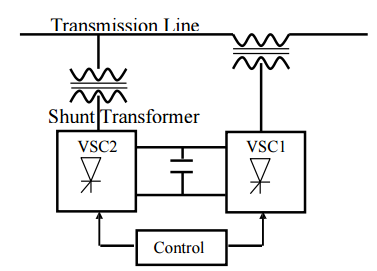
Fig. Schematic diagram of UPFC

The UPFC consists of two branches. The series branch consists of a voltage source converter, which injects a voltage in series through a transformer. The inverter at the input end of the UPFC is connected in shunt to the AC power system and the inverter at the input end of the UPFC is connected in series with the AC transmission circuit. Since the series branch of the UPFC can inject a voltage with variable magnitude and phase angle it can exchange real power with the transmission line. However the UPFC as a whole cannot supply or absorb real power in steady state (except for the power drawn to compensate for the losse.

The Unified Power Flow Controller (UPFC) was proposed' for real turn-off time control and dynamic compensation of ac transmission systems, providing the necessary functional flexibility required to solve many of the problems facing the utility industry. The Unified Power Flow Controller consists of two switching converters, which in the implementations considered are voltage sourced inverters using gate thyristors valves, as illustrated in Fig. These inverters, labeled "Inverter1" and "Inverter 2" in the figure, are operated from a common dc link provided by a dc storage capacitor. 
This arrangement functions as an ideal auto ac power converter in which the real power can freely flow in either direction between the ac terminals of the two inverters and each inverter can independently generate (or absorb) reactive power at its own ac output terminal since the series branch of the UPFC can inject a voltage with variable magnitude and phase angle it can exchange real power with the transmission line. However a UPFC as a whole cannot supply or absorb real power in steady state (except for the power drawn to compensate for the losses). Unless it has a power source at its DC terminals. Thus the shunt branch is required to Transmission Line Shunt Transformer VSC2 VSC1 Control Transient Stability of Power System Using Facts Device-UPFC (IJSRD/Vol. 1/Issue 3/2013/0025) All rights reserved by www.ijsrd.com 507 compensate (from the system for any real power drawn/supplied by the series branch and the losses. if the power balance is not maintained, the capacitor cannot remain at a constant voltage. Shunt branch can independently exchange reactive power with the system. 

For full article Click Here

For More detail about research work
visit us : www.ijsrd.com


Saturday, 8 August 2015

Special Issue For Image Processing

Best 25 papers will be published online.Participate in this special issue and get a chance to win the Best Paper Award for Image Processing. Also other authors will have special prizes to be won.


What is Image Processing?
Image processing is a method to convert an image into digital form and perform some operations on it, in order to get an enhanced image or to extract some useful information from it. It is a type of signal dispensation in which input is image, like video frame or photograph and output may be image or characteristics associated with that image. Usually Image Processingsystem includes treating images as two dimensional signals while applying already set signal processing methods to them. 
It is among rapidly growing technologies today, with its applications in various aspects of a business. Image Processing forms core research area within engineering and computer science disciplines too.Image processing usually refers to digital image processing, but optical and analog image processing also are possible.
Analog or visual techniques of image processing can be used for the hard copies like printouts and photographs. Image analysts use various fundamentals of interpretation while using these visual techniques. The image processing is not just confined to area that has to be studied but on knowledge of analyst. Association is another important tool in image processing through visual techniques. So analysts apply a combination of personal knowledge and collateral data to image processing.
Digital Processing techniques help in manipulation of the digital images by using computers. As raw data from imaging sensors from satellite platform contains deficiencies. To get over such flaws and to get originality of information, it has to undergo various phases of processing. The three general phases that all types of data have to undergo while using digital technique are Pre- processing, enhancement and display, information extraction.
If you have worked on any part of image processing prepare a research paper and submit to us
Image processing basically includes the following three steps.
  • Importing the image with optical scanner or by digital photography.The acquisition of images (producing the input image in the first place) is referred to as imaging.
  • Analyzing and manipulating the image which includes data compression and image enhancement and spotting patterns that are not to human eyes like satellite photographs.
  • Output is the last stage in which result can be altered image or report that is based on image analysis.

Purpose of Image processing
The purpose of image processing is divided into various groups. They are:
  • Visualization - Observe the objects that are not visible.
  • Image sharpening and restoration - To create a better image.
  • Image retrieval - Seek for the image of interest.
  • Measurement of pattern – Measures various objects in an image.
  • Image Recognition – Distinguish the objects in an image.

Applications of Image processing
Image processing has been an important stream of Research for various fields. Some of the application areas of Image processing are….
Intelligent Transportation Systems – E.g. Automatic Number Plate Recognition, Traffic Sign Recognition
Remote Sensing –E.g.Imaging of earth surfaces using multi Spectral Scanners/Cameras, Techniques to interpret captured images etc.
Object Tracking – E.g. Automated Guided Vehicles, Motion based Tracking, Object Recognition
 Defense surveillance – E.g. Analysis of Spatial Images, Object Distribution Pattern Analysis of Various wings of defense. Earth Imaging using UAV etc.
 Biomedical Imaging & Analysis – E.g. Various Imaging using X- ray, Ultrasound, computer aided tomography (CT) etc. Disease Prediction using acquired images, Digital mammograms.etc.
Automatic Visual Inspection System – E.g.Automatic inspection of incandescent lamp filaments, Automatic surface inspection systems,    Faulty component identification etc.
And many other applications…..
To contribute your research work in Image processing please prepare an article on it and submit to us.
http://www.ijsrd.com/SpecialIssue

Saturday, 28 February 2015

#IJSRD #New Milestone #Leading E-Journal #India

Thanks 2 all Authors For Making Fastest Growing E-Journal of INDIA.
IJSRD Successfully Completed 24 Issue.
Submission is open For Volume 3 - Issue 1 ,2015
Papers Received - More then 10000
Total Authors- More then 12000
Accepted Papers - More Then 3200