Thursday, 23 August 2018

Internet of Things Based Controlling of Appliances using GSM/GPRS Enabled Embedded Server for Remote Access | IJSRDV3I50514

Authors: Rajneesh Kumar, Abhinav Kumar Yadav, Sh Nishant Tripathi,
Institute: NIELIT Gorakhpur, UP
Keywords: GSM/GPRS Enabled Embedded Server, Internet of Things based Controlling
Abstract:
The internet has initially started as the “Internet Of Computers”, a global network enabling services that now include the World Wide Web(WWW), File Transfer Protocol and others allowing computers and hence users to communicate with each other and exchange information. There are several definitions for the Internet of Things (IOT) that explain what are the main functionalities of it and what we should expect from when connecting “Things” with each other and with the internet. Internet of Things (IoT) is an ideal emerging technology to influence the internet and communication technologies. Simply “Internet of Things” connects living and non living things through internet. The main aim of this project to enable the users to control and monitor smart devices through internet. In this an interface between users and smart home by using GSM and internet technologies, or simply creating GSM based wireless communication from the web server into the smart home.

DOWNLOAD

For more useful Article Please visit: IJSRD – International Journal for Scientific Research and Development

Thursday, 28 September 2017

IJSRD | Online e-journal

Call For Paper | IJSRD Journal

ISSN (Online)  : 2321-0613
Subject Category    : Engineering Science and Technology
Frequency               : Monthly, 12 issues per year
Last Date                 : 25th of Current Month
Impact Factor          : 4.396 (2016)
IC Value                  : 64.81 (2016)
Publication Charge : 750/- INR (Indian Author) | 50 USD (Foreign Author)


Submit Your Article : Click Here  |  Thousand of published article 


Friday, 4 March 2016

5th NATIONAL CONFERENCE on Computational and Mathematical Sciences (COMPUTATIA-V) : IJSRD

5th NATIONAL CONFERENCE

on Computational and Mathematical Sciences

(March 18th & 19th, 2016)

ABOUT THE CONFERENCE
The Conference proposes to bring together experts, researchers, faculties, students and the leaders of industries for sharing their knowledge and expertise in the field related to Computer and Mathematical Sciences.
We have successfully organized four National Conferences named “COMPUTATIA” since 2011. Following that this year also we are organizing COMPUTATIA-V “Two Days National Conference on Computational and Mathematical Sciences” on March 18th-19th, 2016.
PUBLICATION
Authors are requested to submit their abstracts in MS WORD file format at email-id: computatia.2012@gmail.com orcomputatia@vitej.ac.in on or before 9th March, 2016.
The Selected Papers will be published in IJSRD (International Journal for Scientific Research and Development) having ISSN (online): 2321-0613 and Impact Factor: 2.39
BROCHURE
Brochure front page
Brochure reverse side

Click to Download Registration Form

Thursday, 7 January 2016

CALL FOR PAPERS

CALL FOR PAPERS | IJSRD

International Journal for Scientific Research & Development

Impact Factor: 2.39

Publication charges : 750 INR

Submission Last Date : 25th of Current Month

Publication Last Date : 1st date of every month

We publish original and high quality papers.
Leading E-Journal of INDIA

Indexed in:
Academia 
ISSUU 
Google Scholar  
Scridb  
Research Bible 
Slideshare and many more...

IJSRD is a leading e-journal, under which we are encouraging and exploring newer ideas of current trends in Engineering and Science by publishing papers containing pure knowledge. IJSRD is Trusted by more than 25000 satisfied authors worldwide & growing rapidly.


Thursday, 19 November 2015

Fabrication, Assembly and Testing of Multiwire Proportional Counters

Fabrication, Assembly and Testing of Multiwire Proportional Counters

Author(s):

Lakshmi Dagar , Amity Institute of Applied Sciences (Amity University) Noida, U. P.; Kajol Chakraborty, Amity Institute of Applied Sciences (Amity University) Noida, U. P.; Punita Verma, Kalindi College, University of Delhi, New Delhi; Akhil Jhinghan, Inter University Accelerator Center, Aruna Asaf Ali Marg, New Delhi

Keywords:

Multiwire Proportional Counters, Fabrication, Detector

Abstract

Multiwire Proportional Counter (MWPC), a particle studied under this project is an indispensable part of all nuclear physics experiments involving the study of compound nucleus and fission fragments. The work done under this project involves the fabrication, assembly and testing of a MWPC. The experimental work has been done at Inter University Accelerator Center (IUAC), New Delhi. The MWPC fabricated at IUAC had an active area of 16x11 cm2. Timing resolution and gain of the fabricated MWPC was made to improve over that of already available MWPCs at IUAC by reducing the anode wire pitch and using a ten micrometer diameter wire for anode frame. The fabricated MWPC was thoroughly tested with an alpha source and it was observed that the detector could handle heavy count rate exceeding 20 KHz without any breakdown. Fabricated MWPC was also used in a nuclear physics experiment in the NAND experimental set up of IUAC to extract information about mass, kinetic energy and angular distribution of fission fragments. All the detailed investigations done with the detector were part of the M.Sc. Dissertation work of the first two authors. During under graduation and post-graduation, students study about proportional counters with emphasis on their construction and basic principle of operation. However, this project work provided the first two authors with a unique opportunity of getting a practical experience on how these proportional counters are fabricated and their importance in the field of nuclear physics. Thus, project based learning leaves a larger impact on the mind of the students as far as understanding of concepts of science is concerned

Introduction

A multi wire proportional counter is simply a gas filled wire chamber consisting of a large number of anode wires stretched in a plane for position measurement. The original motivation of developing such detectors came from the need to track particles in high energy physics experiments. The wire chambers, thus developed worked amazingly well and helped scientists make grea discoveries at particle accelerators. Although these chambers are still used in some laboratories, but since the advent ofhigh resolution silicon detectors their utility has somewhat diminished. Fig.1 shows the sketch of a typical multi wire proportional chamber [1]. The closely spaced thin anode wires are stretched in a plane that is midway between two cathode planes. The cathodes are kept at negative potential with respect to anode wires that are kept at ground potential. Each of the anode wires acts as an independent proportional counter and must therefore be read out independently [2].
For full article .... Visit Site ...www.ijsrd.com

Monday, 9 November 2015

IJSRD Conference: (Information and Communication Technologies) & IoT (Internet of Things)

NATIONAL CONFERENCE ON ICT

Transforming ICT to IoT


In association with


IJSRD– International Journal for Scientific Research & Development

SAL Institute of Technology & Engineering Research, affiliated to the Gujarat Technological University, Ahmedabad., is organizing 1-day event named National Conference on ICT”  on 20th January 2016 in association with IJSRD.
The conference aims to provide an opportunity to teachers/mentors/ educators and students to acknowledge, celebrate and showcase research being carried out by students by enabling them to engage with the wider communities to exchange ideas and share intellectual activity through paper presentations sessions. The event shall feature research papers presentations by eminent educators and students from all over India in the field of ICT (Information and Communication Technologies) & IoT (Internet of Things).


Organised by

SAL Institute of Technology & Engineering Research
Opp, Science city, Sola Bhadaj Road,
Ahmedabad, Gujarat 380060
Website : www.sal.edu.in


Publication Partner

IJSRDInternational Journal  for Scientific Research & Development
Website: ijsrd.com

Thursday, 15 October 2015

IJSRD:International Journal for Scientific Research & Development

International Journal for Scientific Research & Development

Visit us on : |  Facebook  |  Twitter  |  LinkedIn  |  Google+  |  

Phone : 8866191212 / 22   |   E-mail : info@ijsrd.com   |   Website : www.ijsrd.com

Wednesday, 23 September 2015

NCIL – 2015 #IJSRD Publication Partner

NCIL - 2015
National Conference on "Student-driven Research for Inspired Learning" in Science and Technology
Organised by ESRC and Dept of Electronics
Publication Partner International Journal for scientific research & Development (IJSRD)
Date: 16-17 October 2015

Saturday, 19 September 2015

Transient Stability of Power System using Facts Device-UPFC

IJSRD Found one good reserch article on Electrical Engineering Department

Abstract— This paper is based on Occurrence of a fault in a power system causes transients. To stabilize the system, The Flexible Alternating Current Transmission (FACTS) devices such as UPFC are becoming important in suppressing power system oscillations and improving system damping. The UPFC is a solid-state device, which can be used to control the active and reactive power.. By using a UPFC the oscillation introduced by the faults, the rotor angle and speed deviations can be damped out quickly than a system without a UPFC. The effectiveness of UPFC in suppressing power system oscillation is investigated by analyzing their oscillation in rotor angle and change in speed occurred in the two machine system considered in this work. A proportional integral (PI) controller has been employed for the UPFC. It is also shown that a UPFC can control independently the real and reactive power flow in a transmission line. A MATLAB simulation has been carried out to demonstrate the performance of the UPFC in achieving transient stability of the two-machine five-bus system.

I. INTRODUCTION

The UPFC is the most versatile of the FACTS devices. The main function of the UPFC is to control the flow of real and reactive power by injection of a voltage in series with the transmission line. Both the magnitude and the phase angle of the voltage can be varied independently. Real and reactive power flow control can allow for power flow in prescribed routes, loading of transmission lines closer to their thermal limits and can be utilized for improving transient and small signal stability of the power system.  
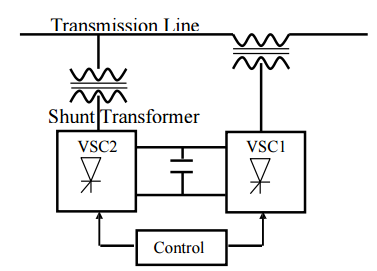
Fig. Schematic diagram of UPFC

The UPFC consists of two branches. The series branch consists of a voltage source converter, which injects a voltage in series through a transformer. The inverter at the input end of the UPFC is connected in shunt to the AC power system and the inverter at the input end of the UPFC is connected in series with the AC transmission circuit. Since the series branch of the UPFC can inject a voltage with variable magnitude and phase angle it can exchange real power with the transmission line. However the UPFC as a whole cannot supply or absorb real power in steady state (except for the power drawn to compensate for the losse.

The Unified Power Flow Controller (UPFC) was proposed' for real turn-off time control and dynamic compensation of ac transmission systems, providing the necessary functional flexibility required to solve many of the problems facing the utility industry. The Unified Power Flow Controller consists of two switching converters, which in the implementations considered are voltage sourced inverters using gate thyristors valves, as illustrated in Fig. These inverters, labeled "Inverter1" and "Inverter 2" in the figure, are operated from a common dc link provided by a dc storage capacitor. 
This arrangement functions as an ideal auto ac power converter in which the real power can freely flow in either direction between the ac terminals of the two inverters and each inverter can independently generate (or absorb) reactive power at its own ac output terminal since the series branch of the UPFC can inject a voltage with variable magnitude and phase angle it can exchange real power with the transmission line. However a UPFC as a whole cannot supply or absorb real power in steady state (except for the power drawn to compensate for the losses). Unless it has a power source at its DC terminals. Thus the shunt branch is required to Transmission Line Shunt Transformer VSC2 VSC1 Control Transient Stability of Power System Using Facts Device-UPFC (IJSRD/Vol. 1/Issue 3/2013/0025) All rights reserved by www.ijsrd.com 507 compensate (from the system for any real power drawn/supplied by the series branch and the losses. if the power balance is not maintained, the capacitor cannot remain at a constant voltage. Shunt branch can independently exchange reactive power with the system. 

For full article Click Here

For More detail about research work
visit us : www.ijsrd.com


Saturday, 8 August 2015

Special Issue For Image Processing

Best 25 papers will be published online.Participate in this special issue and get a chance to win the Best Paper Award for Image Processing. Also other authors will have special prizes to be won.


What is Image Processing?
Image processing is a method to convert an image into digital form and perform some operations on it, in order to get an enhanced image or to extract some useful information from it. It is a type of signal dispensation in which input is image, like video frame or photograph and output may be image or characteristics associated with that image. Usually Image Processingsystem includes treating images as two dimensional signals while applying already set signal processing methods to them. 
It is among rapidly growing technologies today, with its applications in various aspects of a business. Image Processing forms core research area within engineering and computer science disciplines too.Image processing usually refers to digital image processing, but optical and analog image processing also are possible.
Analog or visual techniques of image processing can be used for the hard copies like printouts and photographs. Image analysts use various fundamentals of interpretation while using these visual techniques. The image processing is not just confined to area that has to be studied but on knowledge of analyst. Association is another important tool in image processing through visual techniques. So analysts apply a combination of personal knowledge and collateral data to image processing.
Digital Processing techniques help in manipulation of the digital images by using computers. As raw data from imaging sensors from satellite platform contains deficiencies. To get over such flaws and to get originality of information, it has to undergo various phases of processing. The three general phases that all types of data have to undergo while using digital technique are Pre- processing, enhancement and display, information extraction.
If you have worked on any part of image processing prepare a research paper and submit to us
Image processing basically includes the following three steps.
  • Importing the image with optical scanner or by digital photography.The acquisition of images (producing the input image in the first place) is referred to as imaging.
  • Analyzing and manipulating the image which includes data compression and image enhancement and spotting patterns that are not to human eyes like satellite photographs.
  • Output is the last stage in which result can be altered image or report that is based on image analysis.

Purpose of Image processing
The purpose of image processing is divided into various groups. They are:
  • Visualization - Observe the objects that are not visible.
  • Image sharpening and restoration - To create a better image.
  • Image retrieval - Seek for the image of interest.
  • Measurement of pattern – Measures various objects in an image.
  • Image Recognition – Distinguish the objects in an image.

Applications of Image processing
Image processing has been an important stream of Research for various fields. Some of the application areas of Image processing are….
Intelligent Transportation Systems – E.g. Automatic Number Plate Recognition, Traffic Sign Recognition
Remote Sensing –E.g.Imaging of earth surfaces using multi Spectral Scanners/Cameras, Techniques to interpret captured images etc.
Object Tracking – E.g. Automated Guided Vehicles, Motion based Tracking, Object Recognition
 Defense surveillance – E.g. Analysis of Spatial Images, Object Distribution Pattern Analysis of Various wings of defense. Earth Imaging using UAV etc.
 Biomedical Imaging & Analysis – E.g. Various Imaging using X- ray, Ultrasound, computer aided tomography (CT) etc. Disease Prediction using acquired images, Digital mammograms.etc.
Automatic Visual Inspection System – E.g.Automatic inspection of incandescent lamp filaments, Automatic surface inspection systems,    Faulty component identification etc.
And many other applications…..
To contribute your research work in Image processing please prepare an article on it and submit to us.
http://www.ijsrd.com/SpecialIssue

Saturday, 28 February 2015

#IJSRD #New Milestone #Leading E-Journal #India

Thanks 2 all Authors For Making Fastest Growing E-Journal of INDIA.
IJSRD Successfully Completed 24 Issue.
Submission is open For Volume 3 - Issue 1 ,2015
Papers Received - More then 10000
Total Authors- More then 12000
Accepted Papers - More Then 3200

Saturday, 1 November 2014

IJSRD & TechFest 2014-15 (IIT-Bombay) presents TISC(Conference)

conferenceTechfest International Student Conference is an initiative to bring together the student community and professors with a common research background. TISC marks a step further in our endeavor to promote science and technology among the students by facilitating the exchange of knowledge between academia and industry.

Featured imageTechfest International Student Conference presents a unique opportunity for students to present their work in front of fellow students, senior professors from top universities, industrialists and policy-makers. It aims at giving recognition to students for their research at a relatively young age. An enriching experience to research oriented minds, TISC will give young scientists an insight into the topic, learn new ideas and build networks beneficial for the future.
The theme for the conference is Renewable Energy Systems, potentially the most important aspect of human life in forthcoming decades. TISC is being hosted by IIT Bombay, one of the premier institutes of science and technology in India known for its path-breaking research and quality education.

Friday, 12 September 2014

IJSRD Journal | You Tube

Ijsrd.com | A Review on Design & Analysis Of C-Frame of Pneumatic Power Press Using FEA


A Review on Design & Analysis Of C-Frame of Pneumatic Power Press Using FEA 

Abstract :
Presses are used in industries for a wide variety of uses including blanking, piercing and pressing. There are many different types of presses. The most popular are pneumatic presses and hydraulic presses. Pneumatic presses are 10 times faster than hydraulic presses and they can perform many jobs faster and more efficiently. Metal forming is one of the manufacturing processes which are almost chip less. These operations are mainly carried out by the help of presses and press tools. These operations include deformation of metal work pieces to the desired size by applying pressure or force. Press machine always works under impact load condition. Because of continuous impact the load, frame of press machine always experience continuous tensile stress.

For More Details Clik on below Link
http://www.ijsrd.com/Article.php?manuscript=IJSRDV1I11010